Repair-or-replace guide
Patch or Replace Drywall: Deciding in a Smithville Home
Most damaged drywall can be patched. Replacing a full sheet, or a whole section of wall or ceiling, is the right call less often than people expect, but when it is right, patching anyway just books the same repair twice. Below are the questions to ask, in roughly the order a drywall pro asks them.
Board strength
Press gently around the damage. Firm board with a clean hole or crack in it is a patching job. Board that feels soft, crumbles, swells or flakes at the paper face is spent, and patching onto it leaves new mud sitting on a weak base. It gets cut out until firm board is reached.
Was it wet
Water changes the answer more than size does. A brief, clean leak that was caught early may leave board that dries firm and can be patched. Board that soaked for days, took on floodwater, or shows mold on either face should be cut out and replaced, and the cavity dried before anything goes back. In Smithville, late spring is the wet season, with May the rainiest month in NOAA's normals for the Smithville Lake station, so basement walls are the usual place this question comes up. The basement water repair page sets out the order of work.
How much of the sheet is affected
Size alone does not decide it, but it narrows the choice down.
A hole or crack in one spot
Patch it. Even a hole as wide as a frying pan is usually cut square and filled with a new piece screwed to backing or studs.
Damage spread across the sheet
Several holes, long cracks and gouges across one four-by-eight sheet often cost about the same to replace as to patch one by one, and new board leaves fewer seams to hide.
A whole wall of marks
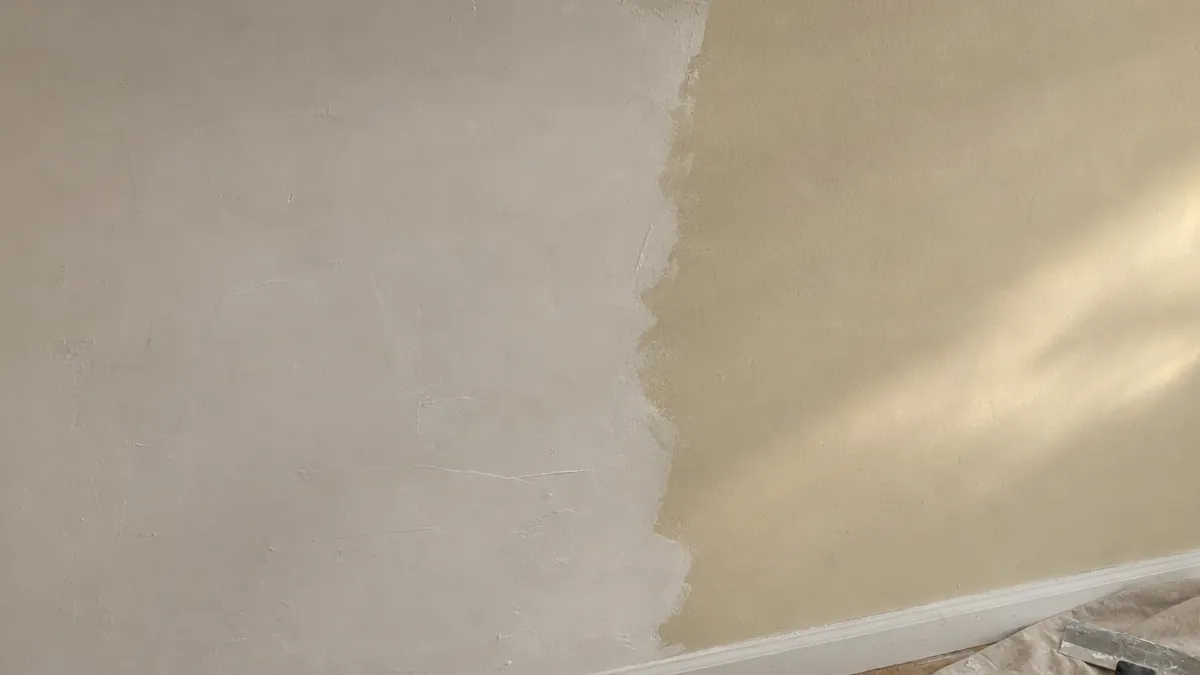
Sometimes the answer is neither: a skim coat, a fine coat of mud over the whole wall, can bring a scarred but sound surface back to smooth without removing any board.
Skim coating as a middle path
A skim coat suits walls that are sound but rough: torn paper from removed wallpaper, a long run of patched anchor holes, or an uneven older finish. Compound is spread thin across the whole surface, left to dry, sanded and usually given a second pass. It takes several days, mostly drying time, and it changes the whole wall, so plan on painting all of it afterward.
Ceilings
Ceiling board that sags between joists, even slightly, has usually been weakened by water or humidity, and re-screwing it rarely pulls it flat for long. A sagging section is normally replaced. Before anything else, if a ceiling is bulging with water, begin at the breaker box by cutting power to the nearby ceiling fixtures; the second is keeping the room beneath it empty. Ceilings textured before the 1980s need an asbestos test before they are cut or sanded.
House age
Census estimates count 506 of Smithville's homes as built before 1960. Walls in houses that old may be plaster rather than drywall, and the right repair for plaster is different again; flag it in your request. In the far larger group of homes dating from the 1990s on, the board is standard drywall and both patching and replacement are straightforward.
What to ask when you get the quote
Ask whether the plan is a patch or new board, and why. Ask how far past the damage the repair will extend, how many coats and drying days it needs, how the texture match will be done, and whether the patch will be primed. A clear answer to each makes it easy to compare.
For holes from knocks, anchors and access cuts, the hole patching page shows how size changes the method. More guides will be added to the guides section over time.